


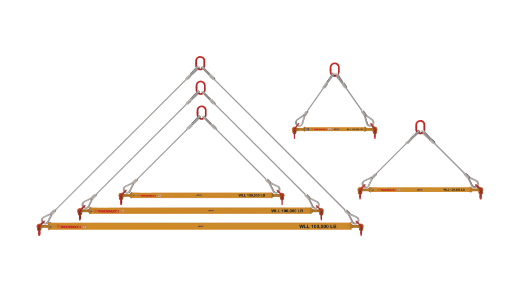
Spreader beams maintain a defined span between two pick points, carrying compression through the beam while the slings remain in tension. For wide or heavy loads, maintaining that separation helps control sling geometry, limit compressive loading on the load, and reduce the potential for tipping, sliding, or bending.
Tandemloc offers several spreader beam configurations for different lifting conditions and load requirements. Choosing the right one hinges on understanding how those configurations differ and which characteristics matter most for the application at hand.
What Are Spreader Beams and How Do They Work?
A spreader beam typically uses a two-leg bridle connected near the beam ends, with lower rigging transferring the load through two separated pick points. The beam carries primarily compressive force while the slings remain in tension, maintaining the required distance between those connection points.
A traditional lifting beam carries bending force instead and generally uses one or more top pick points. That distinction affects headroom, beam weight, and rigging arrangement, but both designs have legitimate applications depending on the lift.
Why Sling Angles Matter When Using Spreader Beams
Sling geometry directly affects the forces within the lifting system. Changes in the upper sling angle affect tension in the sling legs and the forces applied to the rigging and connection hardware.
For that reason, spreader beams should be evaluated by rated configuration, not WLL alone. The required span, sling angle, and approved top and bottom rigging all need to remain within the beam's specified limits.
Fixed vs. Adjustable Spreader Beams
The choice between fixed and telescopic designs is largely determined by how much variation exists between lifts.
- Fixed spreader beams suit repeatable lifts with consistent pick-point spacing. Their simpler construction generally results in a lighter beam, an advantage when crane capacity or total suspended weight is a concern. Our fixed beams are available with WLLs up to 100,000 lbs. and spreads up to 40 ft.
- Telescopic spreader beams accommodate changing load dimensions and pick-point spacing. Our AT14 Series covers WLLs from 2,000 to 100,000 lbs. across multiple adjustment ranges, with custom lengths, capacities, and top rigging configurations also available.
What to Consider When Selecting a Spreader Beam for Lifting
A useful beam specification describes the complete lift rather than a single capacity requirement. Before selecting a spreader beam for lifting, confirm:
- Capacity and span: WLL, required spread, and the exact location of the load's pick points.
- Load and rigging geometry: Load dimensions, center of gravity, available headroom, sling angle, and the required top and bottom rigging.
- Operating range: Whether the beam will remain in one fixed configuration or needs to accommodate several spans and load arrangements.
A higher WLL does not compensate for incorrect geometry. The beam still has to provide the required capacity at the intended spread and within its approved rigging configuration.
When a Combination Spreader/Lift Beam Makes Sense
Operations handling several types of lifts may benefit from equipment that can be configured as either a spreader beam or a lifting beam. That added flexibility can be useful when load dimensions, pick-point locations, or centers of gravity vary across different applications.
Our Combo Lift and Spreader Beams are available in several configurations with different capacities, spans, and pick-point arrangements. These beams are intended to provide facilities with more options when one fixed rigging setup does not cover the full range of lifts they need to perform.
Standard vs. Custom Spreader Beams
The decision between a standard and custom spreader beam usually comes down to how closely the lift matches an existing beam geometry. When span, pick-point spacing, headroom, or rigging requirements fall outside available configurations, a custom design can be built around those constraints rather than adapting the lift to fit a standard beam.
For fixed-length applications, our Rapid Ready Spreader Beams are available with spreads up to 40 ft. and WLLs up to 100,000 lbs.
Choosing the Right Spreader Beam
A well-specified spreader beam reflects the full lifting arrangement, from capacity and span to pick-point locations, center of gravity, headroom, and rigging geometry. Defining those parameters early helps narrow the field to the fixed, telescopic, combination, or custom configuration best suited to the application.
Frequently Asked Questions (FAQs)
What is a spreader beam used for?
A spreader beam maintains separation between lifting points while transferring compressive force through the beam and tensile force through the slings. It is commonly used for wide or heavy loads that benefit from controlled pick-point spacing and more consistent sling geometry.
How do I choose the right spreader beam for lifting?
Choose a spreader beam by matching its WLL and span to the load, then confirm the pick-point locations, center of gravity, headroom, sling angle, and top and bottom rigging all fall within the beam’s rated configuration.
What is the difference between a spreader beam and a lifting beam?
A spreader beam primarily carries compression and normally uses an upper bridle. A lifting beam primarily resists bending and generally connects to the crane through one or more top pick points.
Can spreader beams be adjustable?
Yes. Telescopic spreader beams enable the span to be changed within a defined range. Our AT14 Series is available in multiple adjustment ranges with WLLs from 2,000 to 100,000 lbs.
What information is needed to specify a spreader beam?
Provide the load weight and dimensions, required pick-point spacing, center of gravity, available headroom, and intended top and bottom rigging. For variable lifts, include the minimum and maximum spans the beam needs to cover.
Partner With Tandemloc
Not sure which spreader beam fits your lifting application? Contact Tandemloc with your load weight, dimensions, pick-point spacing, and lifting requirements, and our team can help identify an appropriate standard or custom solution.


