


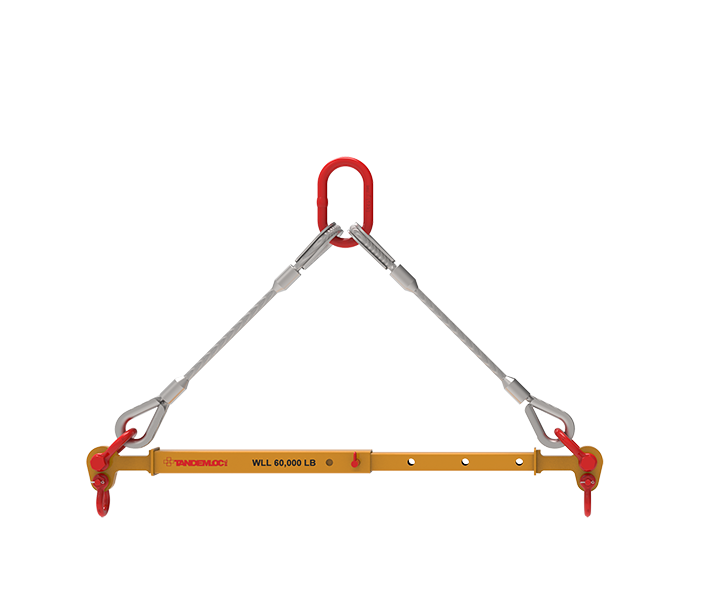
Below-the-hook lifting equipment is used when rigging alone does not provide enough control over the load. This typically applies to lifts involving long spans, multiple pick points, or uneven load distribution where spacing and force direction need to be managed more precisely.
Spreader beams are commonly used in these situations to hold pick points at a fixed distance and keep forces more vertical. In doing so, they transfer compressive force into the beam and tensile force into the slings, which helps reduce stress on the load itself and lowers the risk of tipping, sliding, or bending.
Tandemloc’s equipment is used within this part of the lift process, particularly in applications where crews need to handle varying spans and configurations.
Industry Challenges in Below-the-Hook Lifting
What makes this part of lifting difficult is the variation from one job to the next. Span requirements change, pick points are not always consistent, and there is often limited time to design or fabricate a new beam for each lift.
This leads to a few common issues:
- Equipment that does not match the required span
- Added rigging to compensate for mismatches
- Delays while waiting for custom solutions
None of those are ideal, which is why more crews are leaning more toward equipment that can handle multiple configurations.
Spreader Beams and Load Control in Practice
Spreader beams remain a standard method for managing load spacing and controlling sling angles. Tandemloc manufactures both fixed and adjustable spreader beams with working load limits ranging from a few thousand pounds up to 100,000 lbs, along with a wide range of span options depending on the application.
Fixed spreader beams are still used, primarily in situations where weight or cost is the deciding factor. With less material and simpler fabrication, they are lighter and more economical, which can matter when crane capacity is limited.
Most operations, however, are moving toward adjustable or configurable systems. Rather than using a beam built for a single span, crews are choosing equipment that can be used across multiple lift setups.
End Caps and Modular Below-the-Hook Lifting
End caps are used when a fixed spreader beam cannot cover the range of spans required across different lifts. Tandemloc end caps are paired with pipe cut to the required length, so the beam is built to suit the lift instead of being limited to one size. As an example, certain end cap configurations can accommodate spans ranging from approximately 26 inches up to 24 feet, depending on the setup.
They are often selected for their versatility and ease of use, especially when crews need to handle different span requirements with the same equipment. In practice, that usually comes down to a few things:
- A single set can cover a wide span range instead of requiring multiple beams
- Pipe can be cut to length on-site to match the lift
- Components are easier to store and transport than a fabricated beam
Telescopic Spreader Beams for Variable Lift Conditions
Telescopic spreader beams are used when crews need to adjust span frequently but within a defined range. Instead of cutting pipe or building a new configuration, the beam itself extends and retracts to match the lift.
This becomes useful on jobs with repeated picks where spacing changes but not drastically from lift to lift. Adjustments can be made within a defined range, which helps crews fine-tune the setup without swapping equipment or rebuilding the beam each time.
Like end caps, they are part of the shift away from single-purpose beams. Fixed beams still have a place, but they are typically chosen when weight or cost is the deciding factor. In most other cases, crews are looking for something that can be reused across multiple lift setups.
Engineering, Testing, and Standards Compliance
Below-the-hook equipment is expected to meet established requirements for design, testing, and documentation. Tandemloc equipment is designed and manufactured in accordance with ASME B30.20 and BTH 1 standards and is proof-tested to 125% of its rated capacity.
In many cases, this is assumed as part of the equipment, but it becomes more visible on jobs where documentation is required or where compliance has been an issue in the past. Having that information readily available helps avoid delays during planning and approval.
Use and Customer Experience
Tandemloc end caps and telescopic spreader beams are used in routine crane and rigging work where span requirements change and crews need equipment that can be reconfigured across different lifts.
Users point to build quality and the ability to cover multiple configurations with the same setup, particularly when end caps are used with pipe kept on hand.
“We’ve only recently begun using the tandemloc pipe endlinks for spreader beams. At first I was surprised by their capacity but was skeptical about how useful they’d be. Between the different configurations we have at our shop of 5” and 6 endlinks plus a stock of pipe we’re prepared to tackle any rigging job with same day notice due to their flexibility. When we had an upcoming job in Arizona I knew we could put endlinks and splices on a truck and ship them 2,000 miles and be prepared for any 10 point pick we needed!”
– Tandemloc Customer
Crews are using the same components across different jobs, adjusting span as needed instead of bringing in a different beam for each lift.
Tandemloc’s Impact on Below-the-Hook Lifting Practices
What’s changed in below-the-hook lifting isn’t the need for spreader beams but how often one beam no longer fits the next job. Crews are dealing with changing spans, different pick points, and tighter timelines, and that has pushed the industry toward equipment that can be used more than once without reworking the entire setup.
Tandemloc’s contribution sits in that shift. End caps and telescoping spreader beams are being used in place of single-purpose beams because they cover more ground with the same equipment.
In that sense, the value shows up in how work gets planned and executed. Fewer dedicated beams are needed, lift setups can be handled with what is already on hand, and jobs are less dependent on fabrication timelines when span requirements change.
Contact Tandemloc to learn more about below-the-hook lifting solutions.


