


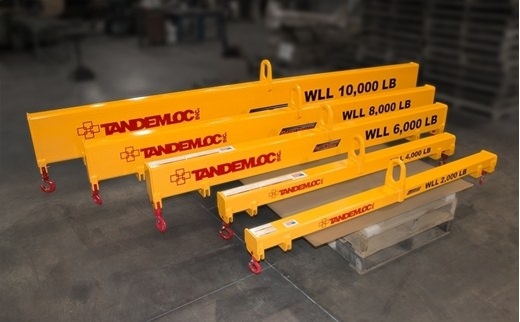
A lifting beam rated above the load weight can still be wrong for the lift. Capacity has to correspond with the beam span, pick-point arrangement, center of gravity, available headroom, and the rigging connecting the beam to the load.
Tandemloc manufactures lifting beams across a range of capacities and configurations, including fixed, adjustable, multi-pick, and low-profile designs. The practical question is not simply how much the beam can lift, but at what span, with what load distribution, and in which approved configuration.
Start With the Maximum Load Weight
The heaviest load the beam will support establishes the minimum Working Load Limit (WLL). That rating identifies the maximum load permitted in service for the beam’s designated configuration.
We mark our below-the-hook lifting devices with their WLL and include the rating on the test certification tag. The marked WLL is an operating limit and should never be exceeded.
Consider the Load’s Center of Gravity
Total weight does not indicate how that weight is distributed. When the center of gravity is offset, one side of the beam and its rigging can carry a different share of the load than the other.
Locate the center of gravity before establishing the pick-point arrangement. We offer lift beam designs with adjustable or multiple top pick points specifically for applications involving uneven or changing centers of gravity.
Match Capacity With the Required Spread
WLL and beam span belong in the same conversation. The distance between lower pick points affects the beam configuration, so capacity should be confirmed at the spread the application will actually use.
We offer lift beams with fixed, adjustable, and multi-pick arrangements across a broad range of spans and capacities. Custom dimensions and capacities are also available when the required spread or lifting geometry falls outside an existing design.
Check the Complete Rigging Setup
A properly rated beam cannot compensate for an undersized sling, shackle, hook, or other component in the load path. Each component should be checked for its own WLL, and usable system capacity cannot exceed the rating of its lowest-rated component.
The lift beam should also be used only at its designated pick points and in an approved configuration. Moving a connection point or changing the rigging can alter the forces carried by the beam and hardware.
Standard vs. Custom Lifting Beams
Standard designs work well when load weight, spread, and pick-point locations align with an existing beam configuration. For applications that fall within defined capacity and spread parameters, our Rapid Ready Lift Beams are available up to 40,000 lbs. WLL with spreads from 12 inches to 20 feet and options for multiple symmetrically positioned bottom lift points.
Applications involving greater capacity, unusual spreads, offset loads, limited headroom, or specialized pick-point arrangements may call for a custom beam. Our engineering capabilities cover custom capacities, sizes, and lifting configurations when a standard model does not suit the application.
WLL vs. Proof Test Load
Working Load Limit and proof test load are not interchangeable. WLL is the maximum rated load for normal service. A proof load is applied during testing to verify the lifting device at a load above its operating rating; it does not increase the beam’s usable capacity.
Tandemloc meets or exceeds ASME B30.20 for all below-the-hook lifting devices. The proof-testing requirement is 125% of rated load, with a tolerance of +5% / –0%. All Tandemloc proof tests are documented and video-recorded for our records.
Regardless of proof-test load, the marked WLL remains the limit for operation.
Quick Guidelines for Selecting Lift Beam Capacity
Before specifying a beam, verify the fundamentals of the lift:
- Establish the maximum load weight and required WLL.
- Locate the center of gravity and determine the required pick-point spacing.
- Confirm available headroom and the ratings of all slings, shackles, hooks, and rigging.
- Verify that the planned pick points and lifting configuration are approved for the beam.
- Consider a custom design when standard lifting beams cannot accommodate the required capacity, span, or load geometry.
Find the Right Capacity for Your Lift
Selecting the right lifting beam capacity involves evaluating the full lifting arrangement, including span, pick points, center of gravity, headroom, and rigging. Reviewing those parameters alongside the beam’s WLL helps determine whether an existing configuration will suit the lift or a custom design is warranted.
Connect with Tandemloc to review your load requirements and identify the lifting beam capacity and configuration best suited to the application.


